What Are Hall Effect Magnetic Switches? A Complete Guide for Competitive Gamers
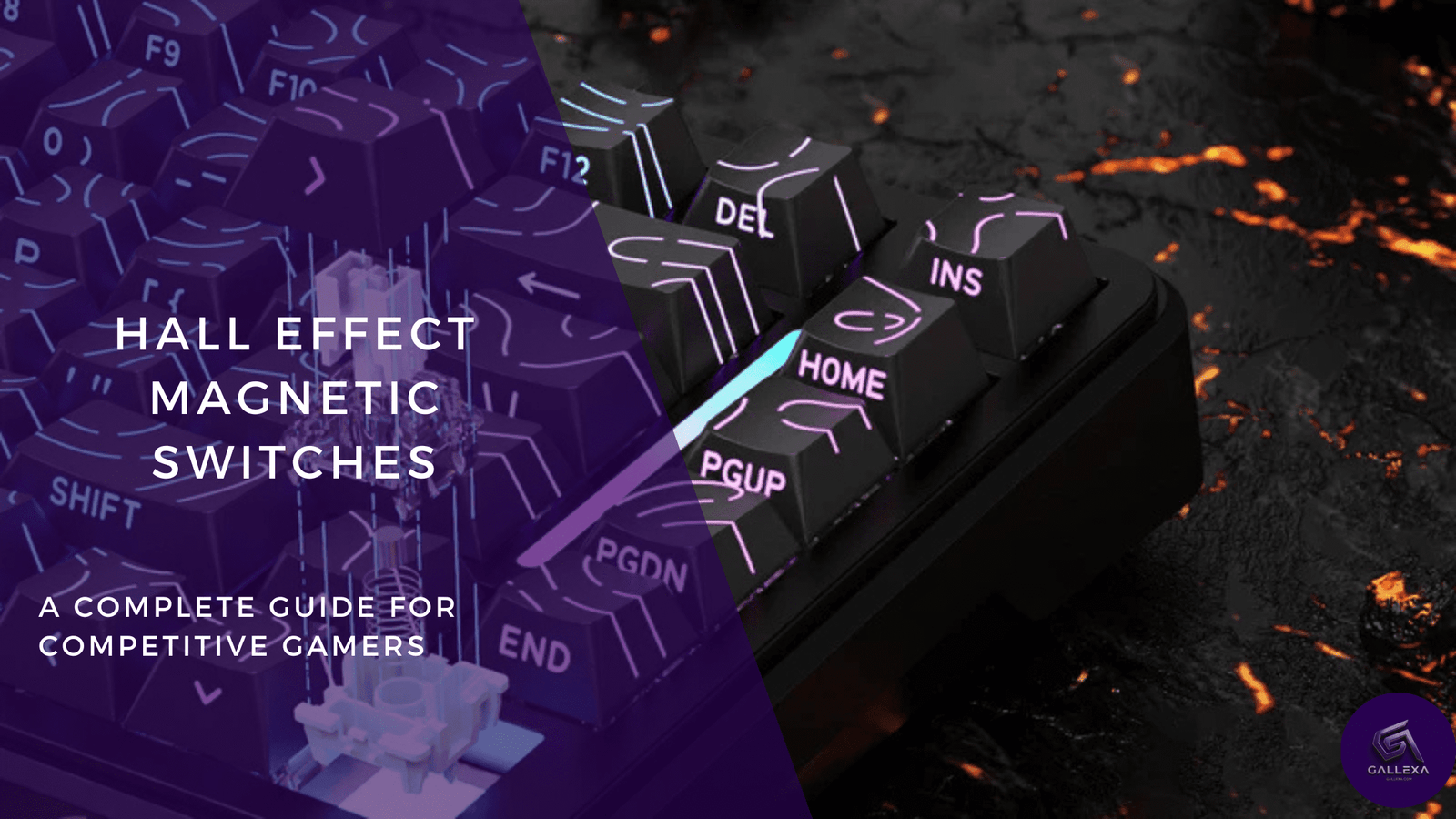
The competitive PC gaming landscape moves incredibly fast. For decades, traditional mechanical switches were the gold standard for esports. But a massive technological shift has taken place. If you look at the gear setups of top-tier professionals in Valorant, Counter-Strike 2, or Apex Legends, you will notice that classic mechanical boards are rapidly being replaced.
The new meta? Hall Effect (HE) magnetic switches.
Advertised as “telepathic” and “blisteringly fast,” magnetic keyboards promise to shave crucial milliseconds off your reaction times. But what exactly is the science behind Hall Effect technology, and how does it translate to a tangible in-game advantage? Let’s dive deep into the ultimate guide to magnetic switches for competitive gamers.
The Science: How Do Hall Effect Switches Work?
To understand why magnetic switches are revolutionary, you first have to look at what makes traditional mechanical switches slow. A standard mechanical switch relies on physical, metal-to-metal contact. When you press a key down, two pieces of metal clap together to complete an electrical circuit.
Because metal vibrates when it strikes metal, the keyboard’s internal firmware has to implement a brief pause called a debounce delay (usually 1ms to 5ms) to prevent a single tap from registering as a double click.
Hall Effect switches completely eliminate physical contact. Named after physicist Edwin Hall, who discovered the phenomenon in 1879, the system operates on simple magnetics:
[Key Stem] contains a small Permanent Magnet
     ↓ (Pressing the key moves the magnet down)
[Keyboard PCB] contains a highly sensitive Hall Effect Sensor
     ↓ (Sensor measures the exact millivolt change in the magnetic field)
[Result] Continuous, real-time tracking of the key's position down to 0.1mm accuracy
Because there are no metal leaves colliding, there is no vibration, zero debounce delay, and virtually non-existent friction. The keyboard always knows exactly how far down the key is at any given fraction of a millisecond.
The Triple Threat: Features That Dominate Esports
This contactless design unlocks three massive software features that are physically impossible to replicate on a standard mechanical keyboard.
1. Fully Adjustable Actuation
On a traditional red or silver linear switch, the actuation point (the exact depth where the keypress registers) is physically fixed at roughly 1.5mm to 2.0mm.
With a Hall Effect switch, the actuation point is completely software-defined. Through your keyboard’s application, you can adjust the activation depth on a per-key basis.
- For a hyper-sensitive hair-trigger in tactical shooters, you can set your
W,A,S, andDkeys to actuate at an incredibly shallow 0.1mm. - For your ultimate or grenade keys, you can set them to a deep 3.0mm to completely avoid accidental misclicks during tense rounds.
2. Rapid Trigger (The Ultimate Game Changer)
Rapid Trigger is the specific feature that caused the entire esports industry to pivot to magnetic switches.
On a normal keyboard, once a key registers, you must lift your finger back up past a fixed physical “reset point” (usually around 1.5mm) before you can press it again.
1.Press Downward:Dynamic Start.
The key registers the instant it passes your custom threshold (e.g., 0.1mm).
2.Lift Finger Upward:Instant Deactivation.
The moment the keyboard senses your finger moving upward by as little as 0.01mm, the input cuts off immediately. You don’t have to wait for the switch to travel back to the top.
3.Re-engage Mid-Travel:Instant Re-actuation.
If you press down again mid-travel, the input re-registers instantly from its current position.
In tactical shooters like Valorant and CS2, stopping your character instantly to guarantee perfect shooting accuracy is called counter-strafing. Rapid Trigger eliminates the physical travel delay of the switch spring, causing your character to halt the absolute millisecond your finger relaxes.
3. Dynamic Keystrokes (DKS)
Because the sensor tracks the full vertical travel of the key, software can map multiple actions to a single keypress. For example, you can configure a key so that a light press inputs a walk command, bottoming the key out inputs a sprint command, and lifting your finger inputs a crouch.
Mechanical vs. Hall Effect: Head-to-Head
| Performance Attribute | Traditional Mechanical | Hall Effect Magnetic |
| Actuation Point | Fixed by hardware (e.g., 2.0mm) | Software adjustable (0.1mm to 4.0mm) |
| Reset Point | Fixed by hardware | Dynamic (Rapid Trigger down to 0.01mm) |
| Debounce Delay | Mandatory (1ms – 5ms to avoid chattering) | 0ms (None required) |
| Keystroke Lifespan | 50 to 100 Million presses | 100+ Million (Zero contact wear) |
| Acoustics & Feel | Distinct tactile bump, click, or linear | Ultra-smooth linear (smooth as silk) |
Is There a Catch? The Limitations of Magnetic Switches
While Hall Effect technology is superior for raw performance, it does carry a couple of minor trade-offs:
Sound and Customization: Because Hall Effect switches require specific magnets paired with the sensors embedded directly into the PCB, they are not compatible with standard MX mechanical hotswap sockets. If you love mixing and matching boutique tactile or clicky switches for typing, you are restricted to linear options within the magnetic ecosystem.
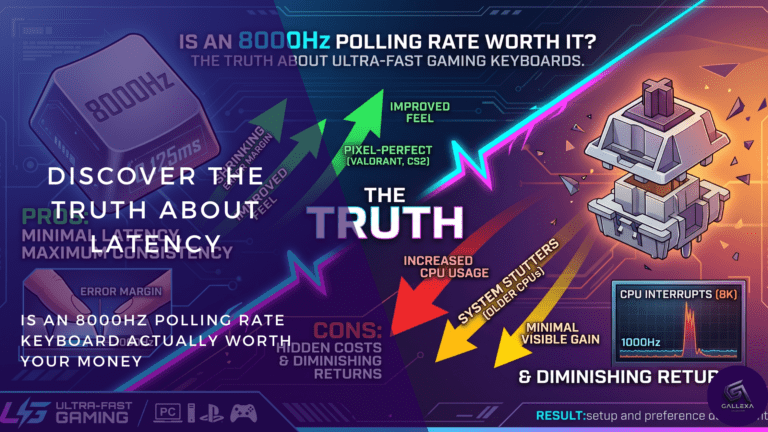
Furthermore, because these sensors continuously track movement, they pair best with high-performance 8000Hz polling rate controllers. This requires a modern processor to handle the non-stop stream of data updates without dropping frames.
Conclusion: Should You Make the Switch?
If you primarily play casual single-player games, MMORPGs, or use your computer for heavy typing workloads, a high-quality traditional mechanical keyboard remains an excellent option.
However, if you are a competitive gamer playing sub-millisecond reaction titles where movement precision dictate your rank, Hall Effect magnetic switches offer a massive, undeniable competitive advantage. The elimination of input latency and mechanical travel limitations makes it the definitive choice for modern esports rigs.
WordPress Publishing Optimization Checklist:
- Focus Keyword:
what are hall effect switchesormagnetic switches gaming keyboard guide. - Meta Description: Want a competitive edge in Valorant or CS2? Learn what Hall Effect magnetic switches are, how Rapid Trigger works, and why pro gamers are making the switch.
- Tags: Gaming Hardware, Esports Gear, Hall Effect Keyboards, Rapid Trigger, Competitive Gaming.
To watch a comprehensive breakdown of how this technology behaves in real-time, you can check out this detailed video explanation of Hall Effect keyboards. It offers an excellent close-up visual demonstration of how magnetic fields alter inputs compared to traditional mechanical layouts.